음악 프로모션
How to Promote EDM Music in 2026

Nadav Peleg
업데이트됨 · 13분 읽기
Not sure how to promote EDM music? Here’s a clear, realistic approach to getting your carefully designed sound in front of the right people.


On this page
- #1 - Pick Your Subgenre and Commit to It
- #2 - Own SoundCloud Before You Touch Anything Else
- #3 - Use SoundCampaign for Niche EDM Playlist Placements
- #4 - Get Your Track on Beatport
- #5 - Register on 1001 Tracklists and Build Your DJ Support Portfolio
- #6 - Submit Demos Directly to DJs (With the Right Format)
- #7 - Use Hypeddit to Gate Your Free Downloads
- #8 - Target Niche Labels, Not the Big Names
- #9 - Post EDM Process Content That Speaks to Producers
- #10 - Pitch EDM Radio Shows
- My Final Advice
- FAQ
You've been producing for 3 years.
You know what sidechain compression sounds like. You can tell the difference between a well-layered kick and a lazy one. You've spent hours on sound design that most listeners won't even consciously notice.
And you're watching tracks with basic drops and $10 sample pack synths hit 50,000 streams while your technically tighter music sits at 200 SoundCloud streams.
As a former music producer, I can tell that’s really frustrating.
In electronic music, great tracks don’t automatically get heard. Promotion decides whether your track dies at 200 streams or finds the audience it deserves.
In this guide, I’ll show you how to promote EDM music so your tracks actually reach people.
#1 - Pick Your Subgenre and Commit to It
This comes before everything else because it determines everything else.
EDM is not a genre. It is about 50 genres. Tech house, techno, progressive house, drum and bass, dubstep, future bass, melodic techno, trance, UK garage, deep house.
Each one has its own blogs, its own Beatport chart, its own set of DJs, its own community. What works in techno doesn’t work in future bass.
The labels, blogs, and audiences are different.
Most producers try to be "EDM" and end up invisible across all of it. The ones who grow pick one specific corner and dominate it. A track that gets picked up by five respected techno DJs in Berlin reaches the right rooms. A track that tries to reach "all EDM fans" reaches none of them.
Before you submit to a single label, pitch to a single DJ, or post on a single platform, name your subgenre. Not "electronic music” or "EDM." The specific thing you make. That one answer shapes every decision after it.
#2 - Own SoundCloud Before You Touch Anything Else
EDM fans discover music differently than fans of most genres. Pop listeners find songs on Spotify or TikTok. EDM fans often find tracks on SoundCloud at 2 a.m., inside DJ sets, or through other producers they follow.
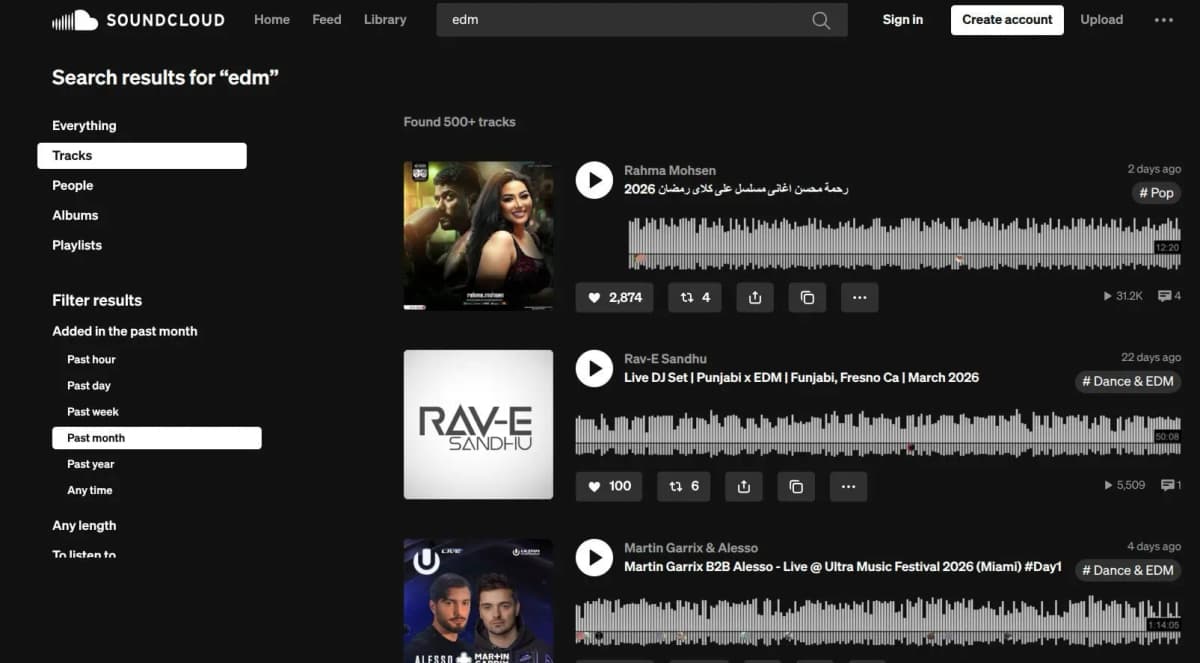
SoundCloud is still a major discovery hub for DJs and producers. Many labels use it to scout talent, and much of the community activity happens there.
Doesn’t seem like it? Go and search “EDM” on SoundCloud and filter all the releases within a month. You’ll see how many streams these tracks are getting within a week.
If your Spotify presence is strong but your SoundCloud presence is weak, many DJs might never find you.
One tactic producers often ignore is posting unofficial remixes and bootlegs. SoundCloud allows these more freely than Spotify.
A good bootleg of a popular track can gain tens of thousands of plays. Those listeners can then move to your original tracks.
This is not about avoiding copyright rules. It is about visibility.
The launchpad mashup by Madeon followed this model. It was not a paid promotion. It spread because the performance was impressive and SoundCloud was where producers discovered each other.
Upgrade to SoundCloud Next Pro if you can. The analytics show who downloads your tracks, where listeners stop listening, and which tracks get shared the most.
That data shows which sound connects with listeners before you spend money promoting it.
Metadata matters more than most producers think. Your genre tag, title, and description affect whether your track appears in SoundCloud Discover and in search results.
Tag tracks with the correct subgenre. Write descriptions that clearly explain the sound and mention influences.
#3 - Use SoundCampaign for Niche EDM Playlist Placements
Niche Spotify playlists with 2,000 focused listeners in your specific subgenre outperform generic "electronic music" playlists with 50,000 passive listeners every time.
The reason is algorithmic. Spotify measures saves, completions, and playlist additions.
Let me tell you a bit about Flip Capella from our case study, who’s actually killing it in the Austrian EDM scene.
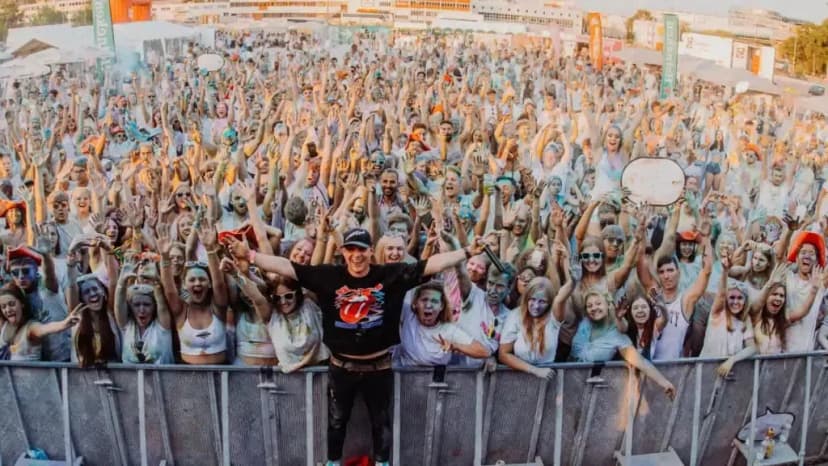
Using SoundCampaign, he picked the right genres and our system pitched him to 29 curators on his behalf. As a result, he got 19 playlist placements out of 29 pitches. And right now, his song Oxygen is sitting over 210K+ streams.
When I started SoundCampaign in 2018, this was exactly the idea. The moment your track lands in a relevant playlist and the audience genuinely connects with it, your chances of building real momentum increase dramatically.
That’s why our curators go through a strict vetting process before joining the platform.
And importantly, we don’t pitch tracks simply to secure placements. We pitch for feedback. If a curator likes your track, they may add it to their playlist. If not, they’ll still provide useful feedback so you know what to improve.
#4 - Get Your Track on Beatport
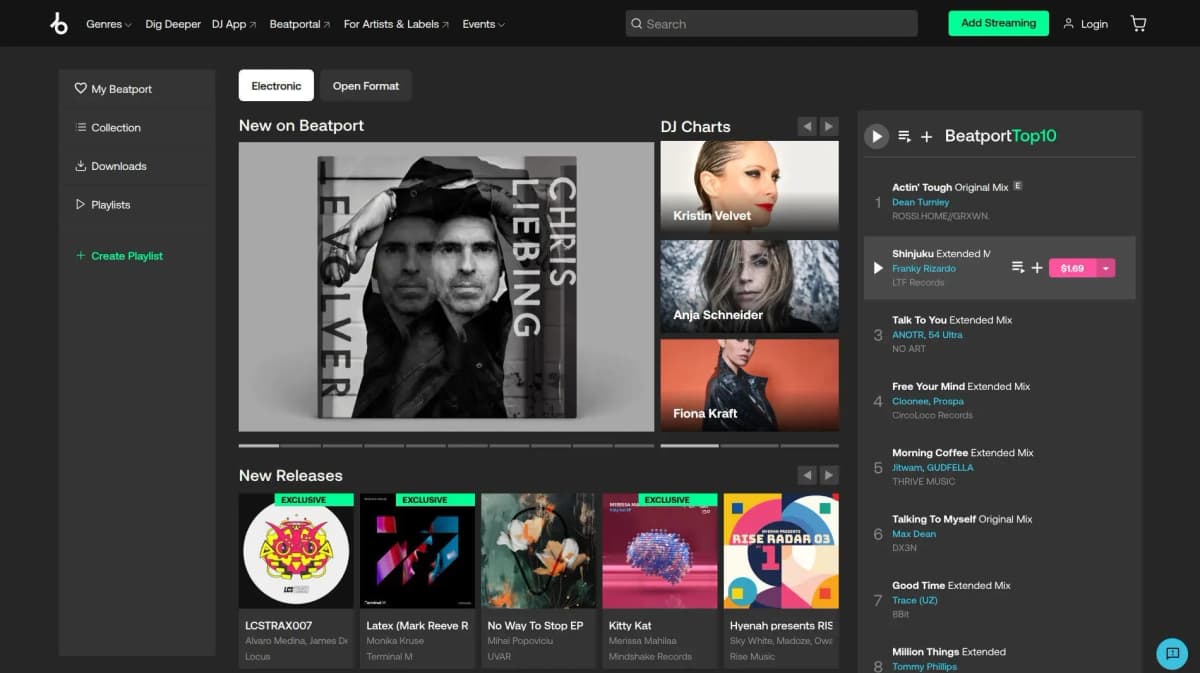
Beatport is where DJs go when they’re actively looking for tracks to play in sets. This isn’t passive listening. This is purchase behavior.
That difference matters.
When a DJ buys your track, they’re far more likely to play it in clubs, include it in mixes, and introduce your sound to new audiences who trust their taste. One strong DJ play can move your track further than thousands of casual streams.
Getting on Beatport usually means releasing through a label or distributor that supports it. This is why label strategy matters. The right label doesn’t just release your track, it puts it in front of DJs who are already searching for music in your exact subgenre.
If you do release on Beatport, think in terms of positioning. A focused subgenre, strong early support, and a well-timed release can push your track into visible spots where DJs browse. Even a small number of purchases in the right niche can create momentum.
What matters here isn’t volume, it’s context. Being discovered by the right DJs at the right moment is what turns a track from a file into something that actually gets played.
#5 - Register on 1001 Tracklists and Build Your DJ Support Portfolio
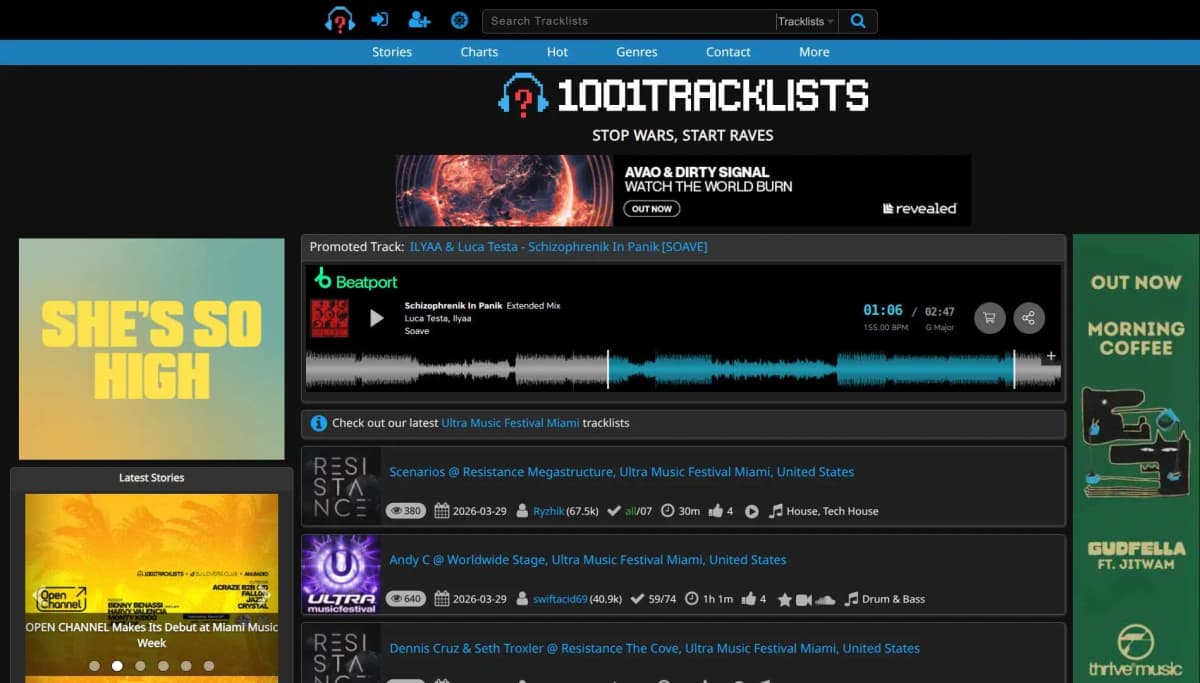
1001 Tracklists aggregates DJ set tracklists from SoundCloud mixes, Mixcloud, radio shows, and live recordings worldwide. When a DJ plays your track in a set and that tracklist gets uploaded, 1001 Tracklists picks it up automatically.
Set up your artist profile. Claim your tracks. This turns every DJ play into a data point you can see and act on.
Here is why this matters beyond vanity: your 1001 Tracklists page is your DJ support portfolio.
When you reach out to a label or a bigger DJ for support, they will look at who has already played your music.
As much as I know, 10 streams by credible DJs in your subgenre signals social proof in a way that stream counts on Spotify do not. Industry people in EDM use 1001 Tracklists the way A&R people at pop labels use Chartmetric.
Identify the DJs who have played tracks similar to yours. They are your first outreach targets.
#6 - Submit Demos Directly to DJs (With the Right Format)
DJ support is one of the most overlooked ways to promote EDM music.
When a DJ includes your track in a mix, their audience hears it through someone they already trust and that trust transfers to you.
Early in his career, Martin Garrix sent demos to DJs like Tiësto, whose support helped him build momentum before his breakout hit Animals.
Start by identifying DJs whose sound matches yours. If they’re already playing tracks similar to yours, they’re the right targets.
Reach out by email, not DMs. Keep it short, show you know their work, and send a private SoundCloud or Dropbox link. Don’t attach files.
Make sure your track is fully mixed and mastered. Send an Extended Mix, and include both MP3 and 16-bit WAV formats if possible.
If a DJ supports your track, acknowledge it publicly. That’s how relationships start and how support compounds over time.
#7 - Use Hypeddit to Gate Your Free Downloads
EDM music has a free download culture that no other genre has to the same degree.
DJs want free WAVs of bootlegs, edits, and remixes to drop in sets. Producers want free downloads of tools, samples, and loop packs.
This culture creates a tactic that doesn’t exist anywhere else in music marketing.
Hypeddit lets you gate a free download behind an action: follow on SoundCloud, repost the track, follow on Spotify, or join your email list.
Someone who wants your free download badly enough to complete the gate action is a highly qualified contact.
Here's the specific play: make a free edit or bootleg of a well-known track in your subgenre. Gate the download on Hypeddit behind a SoundCloud follow and an email signup. DJs find it, literally dying for it lol, and download it.
Joe Rok frequently uses Hypeddit for remixes and mashups.
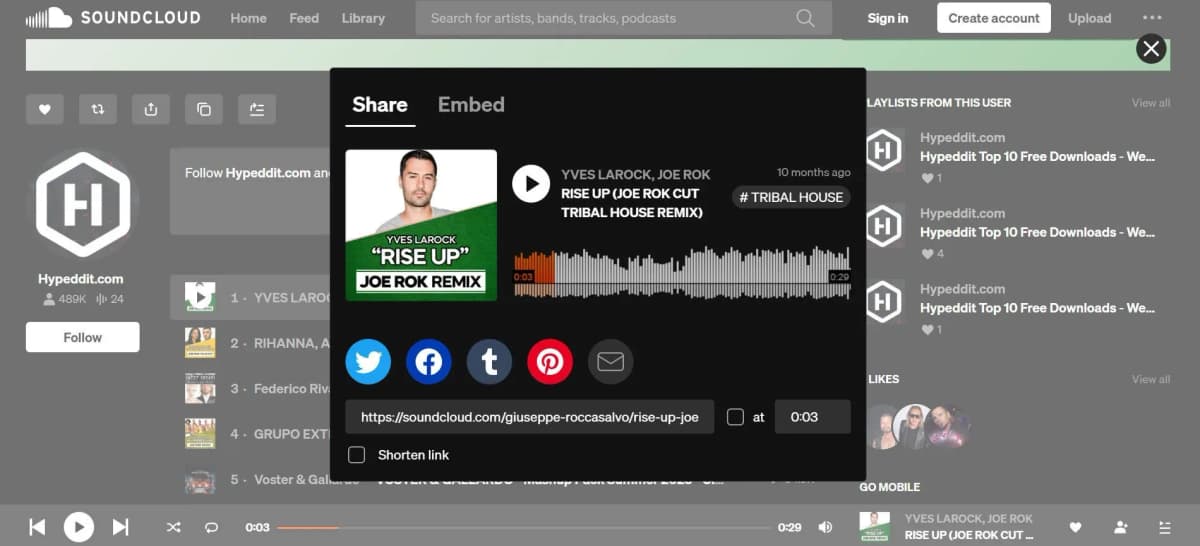
You get the follow and the email. That email address goes into your list, which you use to announce your next original release to people who already know what you sound like.
This is legal when done correctly for bootlegs that are not commercially distributed. It is the same model that built audiences for many producers who are now signed.
#8 - Target Niche Labels, Not the Big Names
Let’s show you some data that you can’t see anywhere else.
|
Label Type |
Estimated Monthly Demo Submissions |
Estimated Acceptance Rate |
|---|---|---|
|
Tech House Labels |
1,000+ |
3% to 5% |
|
Melodic Techno Labels |
700+ |
4% to 6% |
|
Deep Techno Labels |
300 to 500 |
8% to 12% |
|
Niche / Smaller Labels |
200 to 500 |
Often 2 to 3 times higher than large labels |
The smaller the submission volume, the better your odds are. Niche labels with 200 to 500 demos per month often have 2 to 3 times better acceptance rates than the mainstream houses drowning in 1,000+ submissions.
Most producers target the names they recognize from festival lineups. Those are exactly the labels with the worst odds.
The submission protocol is to build a list of 10 to 25 labels that match your specific sound. Not 50 or 100.
Submit to one at a time, or a small batch, and wait 2 to 3 weeks before moving to the next. Send only one or two of your best tracks per label. Never send a demo reel or attach files. Always use a private SoundCloud or Dropbox link.
Your EPK bio should be under 150 words. Include your genre, sound, most relevant stats, and any notable DJ support you have received.
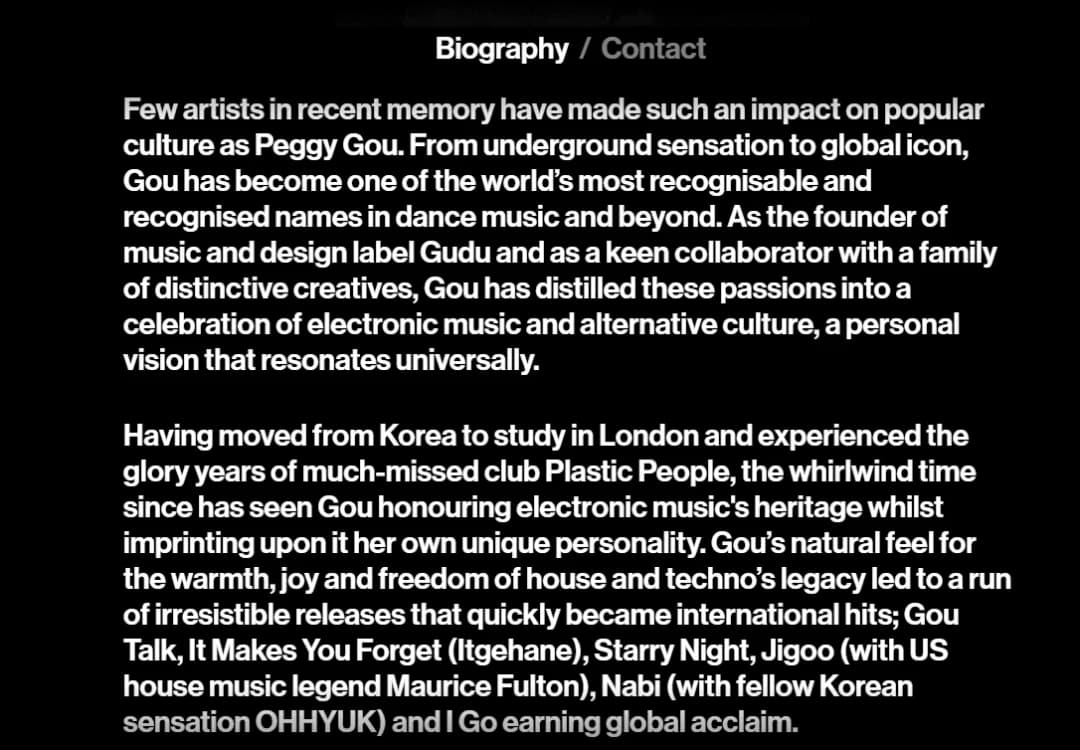
Peggy Gou is a great example:
A&R people at labels receive 100+ submissions daily. The first impression is packaging quality, genre alignment, and professional communication.
The audio is what keeps them reading, but you have to get past the first 10 seconds of the email first.
Never pay a submission fee to any label that asks for one. Reputable labels don’t charge to review demos.
#9 - Post EDM Process Content That Speaks to Producers
Madeon's launchpad performance video went viral. It was something that the EDM community has never seen before.
JNTHN STEIN built a following through Ableton Push videos. Producers watching it could see exactly what was happening and felt the pull of wanting to learn it.
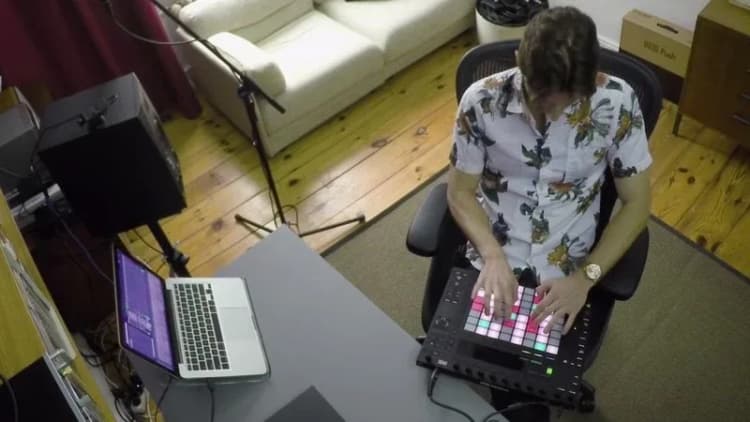
The content that works for EDM on TikTok and Instagram Reels is not generic "making a beat" content. It is specifically showing the sidechain trick that gives your kick that punch, breaking down the wavetable synthesis on that lead you designed, explaining why you chose that particular sample in the intro.
This content works because the EDM community skews towards producers. Producers who love your process become fans. Producers who become fans bring their listeners.
The community you are targeting watches at a level of technical depth that most casual listeners don’t.
If you post a 30-second clip showing you building an 8-bar techno loop with a real explanation of the groove, 500 people who understand exactly what they are looking at will engage at a much higher rate than 50,000 people who vaguely like "electronic music."
#10 - Pitch EDM Radio Shows
This is the channel almost no producer uses. They think it is only for established artists. Tbh, it’s not.
BBC Radio 1's specialist dance shows, Pete Tong's Essential Mix, Annie Mac's programs, Above & Beyond's Group Therapy, Eric Prydz's EPIC Radio, Tiesto's Club Life.
These shows reach hundreds of thousands of listeners who are specifically tuned in to discover new music in the genre.
A single track played on any of these shows can move more of the right listeners than months of Spotify playlist placements.
Said The Sky built early traction through support from radio shows and curated mixes.
Most shows have a demo submission address or a form. It is public. Smaller programs and regional shows are more accessible for emerging artists. Start with those. Once you have a track that has gotten DJ support and is showing up on 1001 Tracklists, that body of evidence makes your submission to a larger program credible.
The EPK you send to radio shows should highlight DJ support specifically. Producers who have already been played by 10 other DJs are a safer bet for a radio show booker than a producer with 0 DJ plays and 50,000 streams.
My Final Advice
You got no budget? Experiment as much as you can with SoundCloud. That’s where your audience is. Who knows a single mix can do wonders within 24 hours.
You got some budget? Try SoundCampaign.
You’ll be able to get your track in front of the right curators. The best case scenario? You’ll land in the most relevant playlists you’ve ever been in.
The worst case? You’ll get feedback from our carefully vetted and experienced curators. So next time, you’ll know what exactly to do to improvise.
FAQ
Is SoundCloud still relevant for EDM?
Yes, and more specifically than for any other genre. SoundCloud is where EDM DJs discover music, where labels scout for talent, and where the producer community connects. A strong SoundCloud presence is more important for EDM than for any other genre because your audience of DJs and producers uses the platform professionally, not casually.
How does SoundCampaign help artists promote EDM music?
SoundCampaign helps you promote your EDM music via Spotify playlist placements, Meta ads, Instagram influencers, and TikTok promotion. Whatever method you choose, you just have to create a campaign with your track’s link, pick the right genre, and submit it. To understand how each promotion strategy works, you can learn more here.
How do I get DJs to support my music?
Find DJs who have played tracks similar to yours by checking 1001 Tracklists for comparable releases. Contact them via email with a short personal message and a private SoundCloud or Dropbox link to your track. Send the Extended Mix in both MP3 and 16-bit WAV format. Use Songstats to track whether they actually listened. When a DJ supports your track, shout them out publicly to start a real relationship.
What acceptance rate should I expect when submitting to EDM labels?
It depends on the subgenre. Tech house labels receive 1,000+ demos per month and accept 3-5% of them. Deep techno labels receive 300-500 demos per month and accept 8-12%. Niche labels with smaller submission volumes have 2-3 times better acceptance rates. Submit to 10-25 labels at most, one at a time or in small batches, and wait 2-3 weeks between outreach.
What is Hypeddit and why would I use it?
Hypeddit lets you gate a free download behind an action: follow on SoundCloud, repost the track, or join your email list. In EDM, DJs and producers actively seek free downloads of edits, bootlegs, and remixes. Gating a free download of a quality bootleg on Hypeddit builds your SoundCloud following and your email list simultaneously from people who are already interested in your sound.
Do EDM radio shows accept demo submissions?
Yes. BBC Radio 1's specialist shows, Above & Beyond's Group Therapy, Pete Tong's Essential Mix, and similar programs all have submission processes. Smaller regional programs are more accessible for emerging artists. The key is to apply after you have existing DJ support you can point to: a tracklist history on 1001 Tracklists is stronger evidence than stream counts when pitching to a radio booker.

SoundCampaign 창립자 겸 CEO
저는 나다브입니다. 지금의 회사를 만들기 전에는 음악을 만들었고, 마케팅에 관심을 갖게 된 것도 거기서 비롯됐습니다. 제가 가장 좋아하는 부분은 분석 쪽입니다. 스트림이 어디서 오는지, 무엇이 움직였고 무엇이 움직이지 않았는지 보는 일이죠. 아티스트에게 진짜 의미 있는 노출을 주기 위해 SoundCampaign을 창업했습니다. 예상보다 훨씬 많은 시간과 노력이 들었고, 그 점은 지금도 크게 다르지 않습니다.

당신의 음악을 알릴 준비가 되셨나요?
매 단계마다 솔직한 피드백과 함께 실제 플레이리스트, 크리에이터, 팬에게 다가가는 수천 명의 인디 아티스트와 함께하세요.
- 봇은 절대 사용하지 않습니다
- 아티스트 보호 프로그램큐레이터나 크리에이터가 트랙을 리뷰하지 않으면 크레딧을 돌려드립니다. 당신의 예산은 항상 보호됩니다.
- 저작권료의 100%를 그대로 유지하세요저희는 레이블이 아닌 프로모션 서비스입니다. 스트림이나 저작권료의 일부도 가져가지 않습니다.