音楽業界
How to Copyright a Song: A Guide for Independent Artists

Nadav Peleg
更新日 · 11分で読了
Learn how to copyright a song in the music industry the right way. See the steps, fees, the wait time and the mistakes indie artists make.
On this page
- What does copyright protect in your song?
- Do you need to register your copyright before you release a song?
- How to copyright a song step by step
- How much does it cost to copyright a song?
- How long does copyright registration take?
- How to copyright a song for free
- Is the "poor man's copyright" real?
- Copyright vs PRO registration: What's the difference?
- What if you wrote the song with someone else?
- Common copyright mistakes independent artists make
- Frequently asked questions
- Final thought
A fake copyright strike is the biggest turn off for artists these days. After spending my time in this industry for than a decade, I've seen that a lot.
Even under US laws, you own the rights of your track the second you record it.
But that’s not it, you got a second headache to deal with. You can’t ignore the registration process.
In this guide, I'll show you what copyright protects, how registration works, the mistakes songwriters keep making, and what it's going to cost you.
What does copyright protect in your song?
A song carries two separate copyrights. Here's how they break down.
|
Copyright type |
What it covers |
Who usually owns it |
|---|---|---|
|
Composition |
The underlying melody and lyrics, the song as written |
Whoever wrote it, split between co-writers if there's more than one |
|
Sound recording |
The specific recorded version, the exact performance and mix |
Whoever recorded it, which isn't always the same person who wrote it |
That split matters more than it sounds. Write a song and record it yourself, and you likely own both. Record a cover of someone else's composition, and you own the sound recording of your performance, but the composition still belongs to the original writer.
Our breakdown of how to release a cover song on Spotify covers the compulsory license you need in that exact situation.
Most disputes among independent artists trace back to this split. A producer who built the beat can hold a stake in the recording without touching the composition. A co-writer who wrote just the hook holds a stake in the composition alone. Sort out who owns what before the song goes anywhere public.
Do you need to register your copyright before you release a song?
No, your copyright exists the moment you record or write the song down. You don't need to register anything before you release it.
But there's something interestingn too. You can't file an infringement lawsuit until you've registered the work.
And you only keep access to statutory damages and attorney's fees if you register before the infringement starts, or within three months after you first release the song. Miss that window, and you're stuck proving losses instead of the bigger, easier-to-win numbers the law hands you when you register on time.
Most working songwriters register right around release. That's when the window's wide open. Sit on it for years, take it for granted, and the strongest protection disappears exactly when you need it most.
How to copyright a song step by step
Copyright.gov runs song registration through its Electronic Copyright Office, or eCO, and the process is built for a single songwriter to handle alone. Here's how it works.
- Create a free account in the eCO system at copyright.gov. After signup, you'll get access to this page where you can notice a lot of services on the left that can help you register your song.
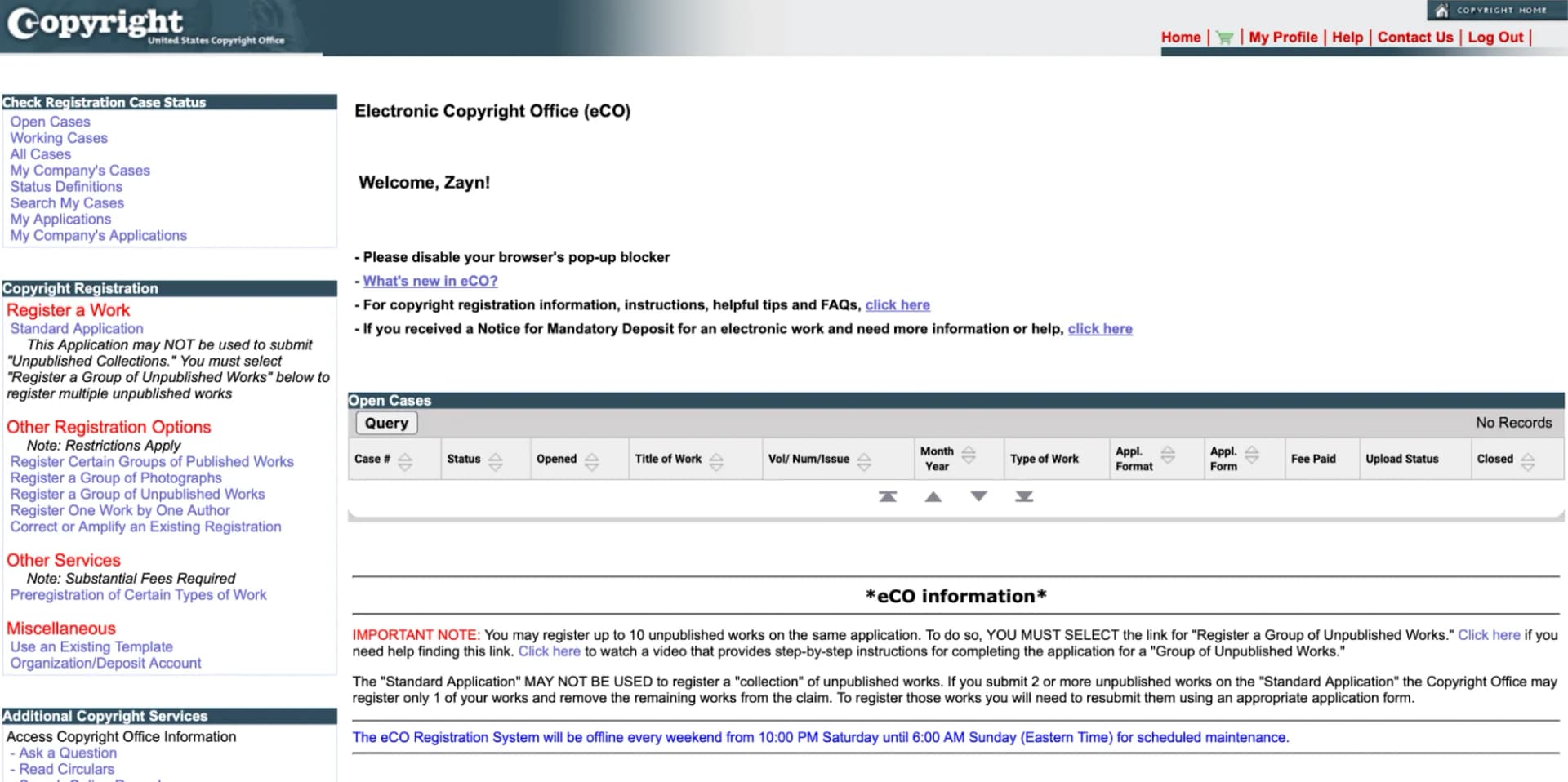
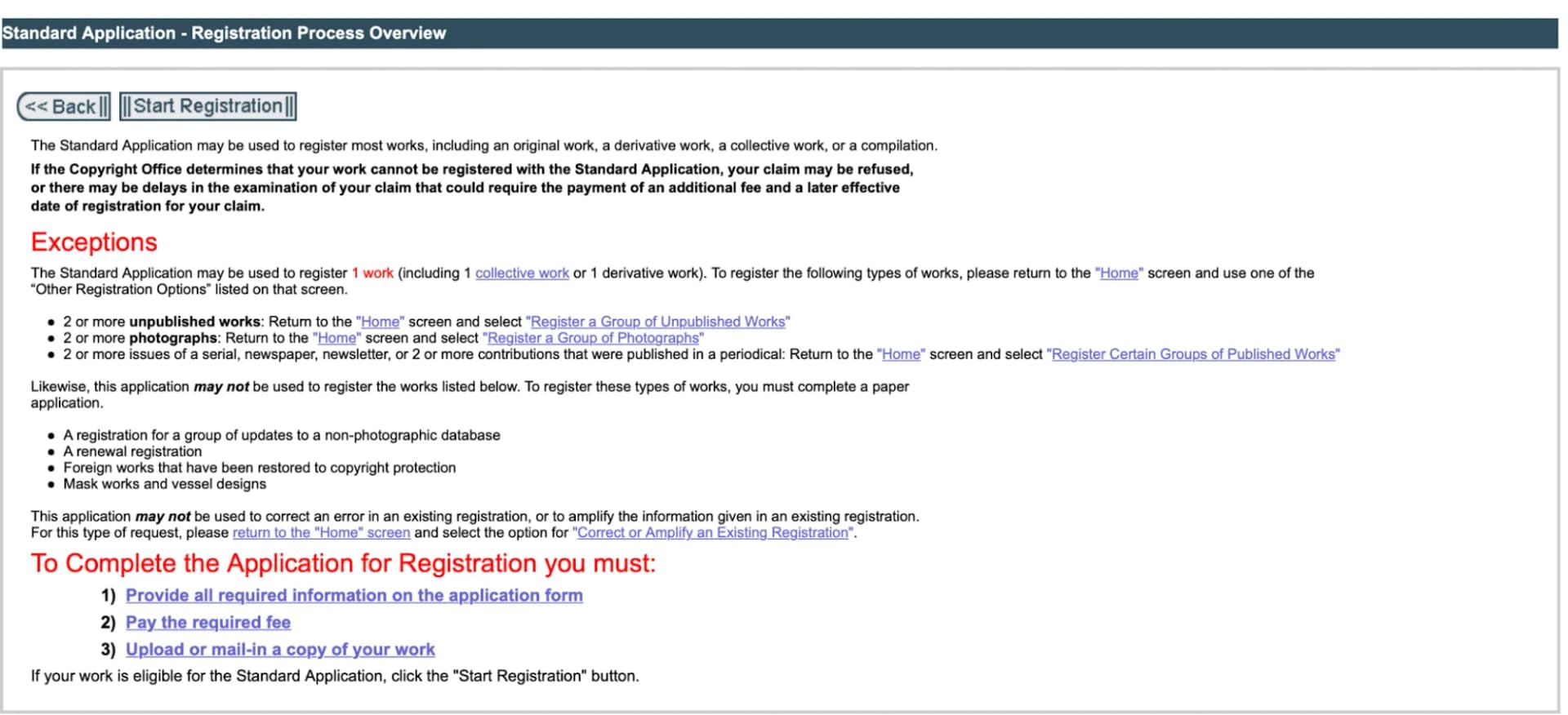
- Pick the right application type. Use the Single Application if you're the only author and the sole owner of one song. Use the Standard Application if you have a co-writer, a work made for hire, or you're bundling multiple songs.
- Select the correct work type for your song and fill out the application form. That's Sound Recording if you're registering the recorded version, Performing Arts for the composition, or both. This is what the application form looks like:
- Pay the fee.
Once you're done, upload your deposit copy, meaning the actual audio file, or the lyrics and sheet music if you have them, to finish submitting.
The whole thing runs online. There's no lawyer, mailed paperwork, or in-person filing needed from your end.
How much does it cost to copyright a song?
As of mid-2026, a Single Application costs $45. That covers exactly one song, with one author who is also the sole copyright owner, filed entirely online through eCO.
Most songwriters end up needing the Standard Application instead, which costs $65. You need this version if you co-wrote the song, if it was made for hire, or if you're registering more than one work in the same claim.
If you have a batch of songs, group registration brings the per-song cost way down. Group Registration of Unpublished Works, or GRUW, covers up to 10 unpublished songs for a flat $85, working out to roughly $8.50 per song. If your songs are already released on the same album, Group Registration for Works on an Album of Music, or GRAM, covers up to 20 tracks for a flat $65, about $3.25 per song.
One heads up. The Copyright Office has proposed raising the Single Application fee to $55 later in 2026. Check the current fee schedule at copyright.gov before you file, since $45 might not hold by the time you read this.
How long does copyright registration take?
Right now, the average copyright registration takes 4.1 months from submission to certificate. That number is elevated because of a government shutdown that ran from October 1 to November 12, 2025, and the Copyright Office expects it to come down as the backlog clears.
Broken down, a straightforward electronic filing that needs no follow-up from the Office averages 3.6 months, with most falling between 2 and 5.3 months. If the Office has to reach out to you for something, average time jumps to 5.0 months, ranging from 1.6 to 8.3 months.
Here's the part that actually matters day to day. Your protection's effective date is the day the Office received your complete application, fee, and deposit copy, not the day your certificate shows up in the mail. You don't need to wait on the paperwork to release your song or defend your rights if something goes wrong in the meantime.
How to copyright a song for free
There is no way to officially register a copyright for free. The Copyright Office charges a filing fee no matter which application you use, starting at $45 for a single song.
As far as I know, what's really free is the protection you already have. The moment you record your song or write it down, U.S. copyright law protects it automatically, no payment required on your part. What you're paying for at copyright.gov is the ability to prove ownership formally and take real legal action if someone steals it.
If cost is the barrier, group registration is your best move once you have more than one song ready. Filing 10 unpublished tracks together under GRUW brings your cost down to about $8.50 a song, the closest thing to a bulk discount the system offers.
Is the "poor man's copyright" real?
Not really. Mailing yourself a copy of your song doesn't create any legal protection, no matter how official the sealed envelope looks.
The U.S. Copyright Office addresses this exact trick in its own FAQ. Their answer leaves no room for doubt. "There is no provision in the copyright law regarding any such type of protection, and it is not a substitute for registration."
On Reddit, I noticed something that'd make you believe this even more. This thread is 8 years old, but artists used to believe it's an old wives tale at that time. So after all those years, I don't think that's gonna work at all.
View original comment on Reddit ›Just like in the old days, mailing yourself a copy, was an old wives tale.
It's even debunked explicitly on USCO's website (copyright.gov), but the myth persists.
The practice of sending a copy of your own work to yourself is sometimes called a "poor man's copyright." There is no provision in the copyright law regarding any such type of protection, and it is not a substitute for registration.
So, skip the envelope trick. If that song really matters to you a lot, try filling the application form for it.
Copyright vs PRO registration: What's the difference?
Copyright registration and PRO registration solve two completely different problems. Copyright registration protects your ownership of the song. PRO registration is how you get paid when it's performed publicly.
A PRO, short for performing rights organization, is an organization like ASCAP or BMI in the US. BMI's own answer to songwriters makes the split clear. Your composition is copyrighted automatically when the work is created, and registering that copyright is recommended but not required.
BMI does not copyright works for you. Its job is collecting performance royalties and paying them out to affiliated writers.
ASCAP describes its own role the same way. ASCAP does not register music for the purpose of copyright protection, since that responsibility sits entirely with the U.S. Copyright Office.
This mix-up trips artists up constantly. One songwriter on r/WeAreTheMusicMakers had to correct someone mid-thread over it.
View original comment on Reddit ›Registering with a PRO does NOTHING to protect your Copyright.
View original comment on Reddit ›It is proof you own the publishing of a song, I just dealt with this in court and own a record label but believe the guy above me. Yeah PROs do nothing except time stamp your release along with distro and they corroborate each other. But listen to this idiot above and mail it to the copyright office but I promise if you write hundreds of songs you aren’t going to and what I just listed is something you need to do anyway that will prove in court you own the songs you say you do.
To answer the previous question: You have to sign up as a writer and publisher once, takes a few minutes to register a song. Costs about 75$ for signing up as a writer and then another 75$ as publisher through ascap
Do both in either order, but understand what each one buys you. A publisher can help manage both sides once your catalog grows past a song or two, chasing registration and royalty collection so you don't have to.
What if you wrote the song with someone else?
Co-writing a song makes you joint owners of the copyright by default, whether or not you ever put that in writing. Courts have consistently read that to mean an equal, undivided share for each co-writer unless you agree to something different in writing, and that agreement needs to happen before release. Waiting until the song takes off is how these disputes start.
A split sheet is the fix. It's a simple written record naming every contributor and their exact percentage, signed by everyone involved. Get it done the same day you finish the song, while everyone still agrees on who did what.
Skip it, and you're setting up exactly the kind of heartbreaks I see quite often on Reddit.
View original comment on Reddit ›Yea its a tough lesson to learn. I was too trusting... you try to give people an opportunity and they just throw it in your face sometimes. I am going to be much more careful about who i work with from now on. I do have pretty strong evidence... for example one of the melodies she says she wrote i recorded a couple of years ago and sold a bunch of CDS with the exact melody on it. I also have copies of the emails that i sent to her with my original lyrics. I suppose we should have discussed royalty splits before hand though.
The same discipline applies anywhere you're handing part of your rights to someone else, including a label deal. Our guide on the pros and cons of signing to a record label covers what to check before you sign away more than you meant to.
Common copyright mistakes independent artists make
A few mistakes show up over and over with independent artists, and every one of them is avoidable.
- Confusing distribution with registration: Uploading to Spotify or Apple Music doesn't register anything with the Copyright Office. Distribution and registration are two separate actions entirely.
- No split sheet before release: Handle ownership before the song goes live, not after it starts making money.
- Trusting the poor man's copyright myth: A sealed envelope is not a substitute for registering with copyright.gov.
- Overpaying a "copyright service" for a $45 job: Some sites charge a markup to file a form you can submit yourself directly through eCO, no middleman required. One artist warned other musicians after a site like this misattributed their tracks, then demanded a fee to fix it. "It seemed like an amazing deal and our guitarist quickly signed us up."
- Push promotion before the paperwork's done: Once a track is out and picking up momentum through a promotion campaign, an unresolved ownership dispute gets far more expensive to untangle. Settle the paperwork first, then push the song hard.
Run through your release checklist before your next drop, and put copyright and splits on it right next to your distributor and your ISRC codes.
Frequently asked questions
How much does it cost to copyright a song?
A Single Application costs $45, covering one song with one author and owner. Most songwriters use the $65 Standard Application instead, since it covers co-writers and multiple works. The Copyright Office has proposed raising the Single Application fee to $55 later this year, so check the current schedule before filing.
Can I copyright a song for free?
Not officially. Every registration through the Copyright Office carries a fee starting at $45. What's already free is the protection you get automatically the moment you record or write the song, registration just gives you the ability to enforce it.
What is the poor man's copyright, and does it actually work?
It's the old trick of mailing yourself a copy of your song and leaving the envelope sealed as supposed proof of ownership. The U.S. Copyright Office states directly that there's no provision in the law for this kind of protection, and it's not a substitute for registration. Skip it and file a real application instead.
How long does a song copyright last?
For a song written by a living individual author, copyright lasts for the author's life plus 70 years. If the song was created as a work made for hire, protection runs for 95 years from publication or 120 years from creation, whichever ends first.
Do I need a lawyer to copyright my song?
No, a single song with one author is straightforward enough to register yourself through the eCO system without paying someone else to do it. A lawyer becomes worth the cost once you're dealing with complicated co-ownership, a dispute, or a catalog large enough that group registration strategy actually matters.
Final thought
Register your song the day it's ready. Get every co-writer's signature on a split sheet before release. That's the one fix you need before anything gets leaked.
Your copyright kicks in the second you write or record it. That's automatic and free stuff.
But suing on it, or collecting statutory damages, requires registering within three months of release. That's about $45 for a Single Application. About $8.50 a song if you bundle unreleased tracks under GRUW.
Skip the envelope trick. It's just an old wives' tale. Skip the markup services too, since eCO takes twenty minutes on your own.
Don't mix up a PRO signup with copyright protection either. ASCAP and BMI collect your royalties, not your ownership rights.
Register early, sign the split sheet. Skip every myth in between. That's it, you've got the entire copyright game in your hands now.

SoundCampaign 創業者兼CEO
ナダブです。今のこの会社を作る前は音楽を作っていて、マーケティングへの関心はそこから生まれました。一番好きなのはアナリティクスの部分、つまりストリームがどこから来て、何が動いて、何が動かなかったのかを見ることです。 SoundCampaignを設立したのは、アーティストに本当の意味での露出を届けるためです。想定していたよりはるかに多くの時間と労力がかかり、それは今もあまり変わっていません。
音楽をプロモーションする
実在するプレイリスト掲載、TikTok動画、Meta広告

100,000以上のアーティスト・レーベルに信頼されています
ボットは一切なし。
あなたの音楽を届ける準備はできましたか?
SoundCampaignを使って、実在するプレイリストやクリエイター、ファンにリーチしている何千人ものインディーアーティストに加わりましょう。すべての段階で正直なフィードバックが届きます。
- ボットは一切なし
- アーティスト保護プログラムキュレーターやクリエイターがあなたの楽曲をレビューしなかった場合、その分のクレジットを返還します。あなたの予算は常に保護されています。
- ロイヤリティは100%あなたのもの私たちはレーベルではなく、プロモーションサービスです。あなたの再生数やロイヤリティから手数料を差し引くことはありません。