統計とインサイト
Spotify Statistics 2026

Azfar
更新日 · 17分で読了
This page highlights the key Spotify statistics of 2025 and explains why they matter for artists looking to grow their audience right now.


On this page
- Spotify User Statistics and Demographics 2026
- Revenue and Financial Performance Data
- Artist and Music Library Statistics
- Top Artists and Streaming Performance 2025
- Playlist and Discovery Statistics
- Geographic and Market Data
- Podcast and Audio Content Statistics
- Mobile vs Desktop Usage Patterns
- Competition and Market Share Analysis
- What These Statistics Mean for Independent Artists
- 2025 Predictions and Future Trends
- Conclusion
Spotify is bigger than ever.
Bruno Mars leads with more than 150 million monthly listeners, while Taylor Swift has surpassed 100 billion total streams.
At the same time, about 60,000 new songs are uploaded daily, and most tracks never reach 1,000 streams.
Independent artists sit right in the middle. In 2024 they earned over $5 billion in royalties, nearly half of all payouts on Spotify. The opportunity is massive, but so is the noise.
Spotify User Statistics and Demographics 2026
Total User Base and Growth Trends
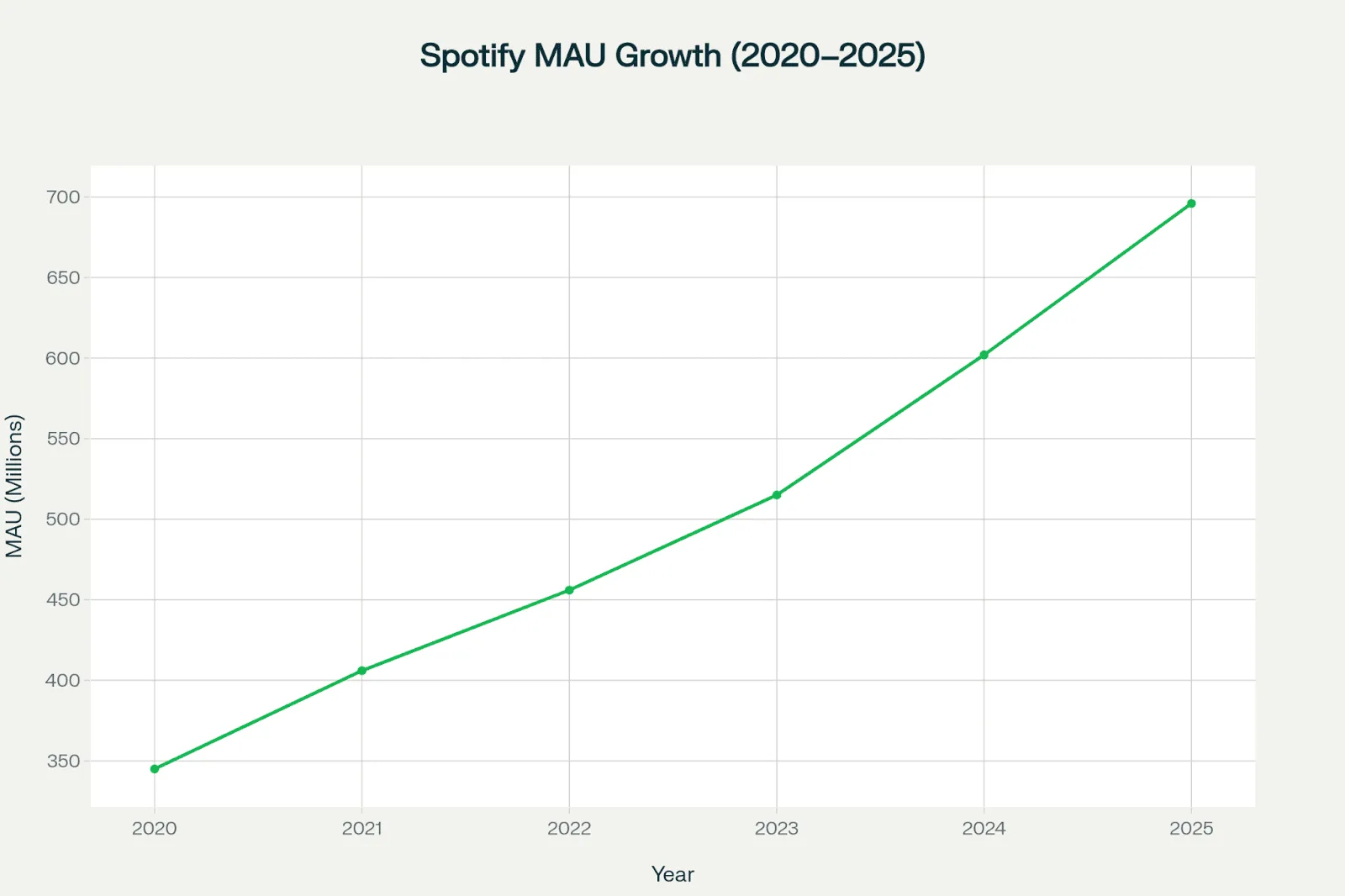
Spotify’s growth is staggering.
As of 2025, it has 696 million MAU, up from 602 million in Q4 2023.
This makes Spotify the largest music streaming service in the world, far ahead of Apple Music, Amazon Music, and YouTube Music.
Premium vs Free User Distribution
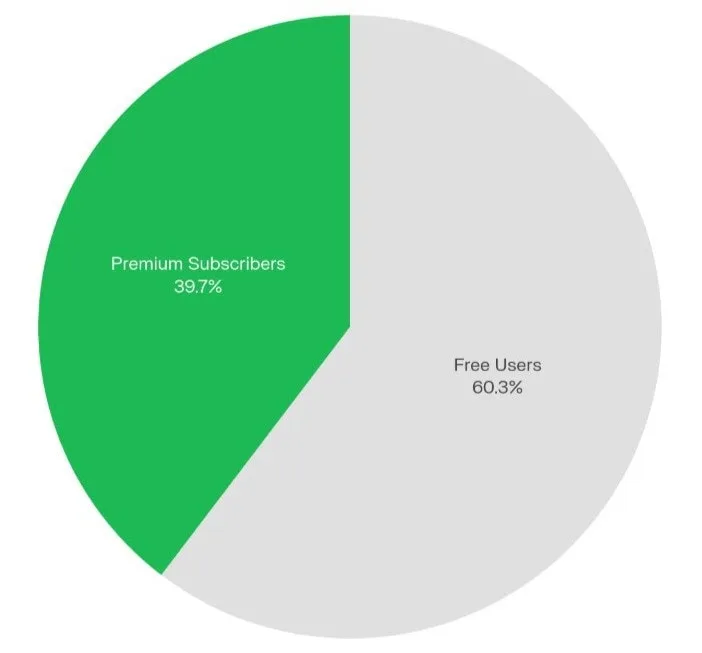
Revenue depends heavily on who is paying. As of Q2 2025, 276 million listeners (39.7 percent) subscribe to Premium, while the rest use the free, ad-supported tier.
Premium subscribers are critical. They generate higher payouts for artists. Roughly, $0.005 per stream compared to $0.002-$0.003 from free users.
Source: SoundCampaign
Global User Demographics by Age and Region
Spotify is now active in 184 countries, with its listener base distributed globally:
- Europe: 27% (182 million MAUs)
- Latin America: 22% (149 million MAUs)
- North America: 17% (115 million MAUs)
- Rest of World: 34% (230 million MAUs)
Growth is fastest in emerging markets. Sub-Saharan Africa saw a 22% increase in MAUs year over year, India has 84 million users, and Asia-Pacific now represents more than a third of Spotify’s total base.
Source: SimpleBeen, Search Logistics
Daily and Monthly Active User Patterns
Listening habits differ by region and device.
Globally, 72% of sessions start on mobile, with desktop at 19% and smart speakers/wearables at 9%.
Mobile listening peaks at 8 a.m. and 6 p.m. on weekdays, while desktop use is highest during work hours.
On average, users stream 114 minutes a day, with Premium subscribers averaging 142 minutes.
Gen Z leads at 126 minutes daily, while Brazil tops the world with 2.4 hours per day.
Artists who understand this behaviour through Spotify Artists Analytics can time releases and promotions for maximum impact.
Source: SQL Magazine
Age & Gender Demographics
Spotify’s audience isn’t just massive, it’s well defined. Age and gender splits show exactly who dominates the platform:
Age brackets:
|
Age Group |
Percentage |
|---|---|
|
18–24 |
26% |
|
25–34 |
29% |
|
35–44 |
16% |
|
45–54 |
11% |
|
55+ |
19% |
Gender: 56% of Spotify’s global users identify as female, while 44% are male
For artists, this matters. The heaviest-streaming group is 18–34, making up over half the audience.
If your music targets Gen Z and Millennials, Spotify must be your go-to platform for releases. The female majority also shapes playlist trends, especially in pop, R&B, and emerging indie subgenres.
Source: The Business Model Analyst
Revenue and Financial Performance Data
Spotify's Annual Revenue and Growth
Spotify’s financial engine is still accelerating.
In Q2 2025, the platform generated €4.2 billion ($4.86 billion) in revenue, up 10% year over year.
Operating income hit €406 million ($460 million), a 50% jump, though the company still reported a net loss of €86 million ($97.5 million) for the quarter. Gross margin rose to 31.5%, showing improved efficiency.
Zooming out, 2024 was Spotify’s first profitable year, with €15.7 billion ($16.9 billion) in revenue and €1.14 billion ($1.17 billion) net income.
Over the last twelve months, revenue reached $18.1 billion, confirming steady growth despite profitability remaining inconsistent.
Source: Variety, Music Business Worldwide
Artist Payouts and Revenue Per Stream
For artists, revenue per stream is where reality bites. Spotify pays between $0.003 and $0.005 per stream, with Premium listeners driving higher payouts. On average:
- Premium streams: ≈ $0.005
- Free streams: ≈ $0.002–$0.003
- Global average: ≈ $0.0038
Geography also plays a role. Streams in the US average $0.0039, while India averages only $0.0008, and Portugal sits near $0.0018.
A million streams typically earn $3,000–$5,000 before distribution cuts.
Source: Spotify, SoundCampaign
Premium Subscription Revenue vs Ad Revenue
Subscriptions remain Spotify’s cash cow.
In Q2 2025, Premium revenue hit €3.74 billion ($4.24 billion), up 16% year over year, making up 88% of total company revenue.
Average revenue per Premium user (ARPU) climbed to €4.57 ($5.18) monthly, up 3% from 2024. By comparison, ad-supported revenue continues to lag, accounting for only 12% of overall income.
For independent artists, understanding this revenue split is key. Since Premium streams pay more.
In this regard, professional promotion services like SoundCampaign help artists target the audiences most likely to subscribe, maximizing ROI and ensuring campaigns generate higher-paying streams.
Source: Music Business WorldWide, Spotify
Artist and Music Library Statistics
Total Number of Artists on Spotify
Spotify now hosts over 11 million artists worldwide. In 2024 alone, 1.7 million new artists joined, averaging about 4,600 sign-ups per day.
Despite this growth, most struggle for traction.
Only 1.58 million artists (14%) attract more than 10 monthly listeners, showing how steep the curve is between uploading music and reaching an audience.
Source: RouteNote
Songs Added Daily and Total Catalog Size
Spotify's catalog continues to grow at an impressive rate, now surpassing 126 million songs as of 2024, significantly expanding from previous counts of over 100 million.
The volume of new music added daily has also surged, with approximately 112,000 new tracks uploaded every day across streaming platforms in 2023, translating to about 43 million new tracks annually.
This rapid pace averages to one new track every 0.8 seconds, highlighting the massive scale of opportunity and intense competition faced by artists today.
Source: WrightyMedia, Billboard
Distribution of Monthly Listeners Across Artists
The distribution of listeners is heavily skewed.
- Only 19% of artists cross the 1,000 monthly listeners mark.
- Nearly 86% of all tracks stay under 1,000 plays.
- About 45.6 million songs have never been played once.
- To break into the top 1% of artists, you need roughly 240,000 monthly listeners.
- Just 12,000 artists worldwide surpass the 1 million monthly listeners threshold.
These numbers show a clear divide: the majority fight for attention, while a tiny fraction capture massive reach.
Source: RouteNote
What Percentage of Artists Earn Significant Revenue
Streaming income reflects this concentration. Spotify pays $0.003–$0.005 per stream, which translates to about $3,000–$5,000 per million streams.
At scale, the numbers are staggering. Taylor Swift’s catalog alone has generated an estimated $415 million from 108+ billion streams.
For most, however, earnings remain minimal, since the vast majority of tracks never achieve significant play counts.
Source: Loud & Clear, Chartmasters, Business of Apps, RevisionsMusic
Top Artists and Streaming Performance 2025
Most Streamed Artists by Monthly Listeners
Spotify’s top charts remain a high-stakes arena. As of September 2025, here are the top 20 artists.
|
Rank |
Artist |
Monthly Listeners |
|---|---|---|
|
1 |
Bruno Mars |
111,818,464 |
|
2 |
The Weeknd |
110,578,529 |
|
3 |
Justin Bieber |
99,081,909 |
|
4 |
Lady Gaga |
96,989,415 |
|
5 |
Ed Sheeran |
95,567,385 |
|
6 |
Coldplay |
94,930,997 |
|
7 |
Rihanna |
91,094,127 |
|
8 |
Billie Eilish |
88,782,757 |
|
9 |
Taylor Swift |
88,561,909 |
|
10 |
David Guetta |
81,111,347 |
|
11 |
Drake |
80,917,781 |
|
12 |
Bad Bunny |
79,332,960 |
|
13 |
Ariana Grande |
77,146,002 |
|
14 |
Kendrick Lamar |
75,105,478 |
|
15 |
Calvin Harris |
71,841,108 |
|
16 |
Maroon 5 |
71,303,533 |
|
17 |
SZA |
68,800,126 |
|
18 |
Post Malone |
68,031,338 |
|
19 |
Sabrina Carpenter |
67,948,375 |
|
20 |
J Balvin |
67,799,989 |
Source: Spotify Charts, ChartMasters, SpotifyPie
Highest Earning Artists on Spotify
At superstar scale, earnings become extraordinary. With per-stream payouts averaging $0.003–$0.005, the top artists have converted billions of plays into massive revenue:
- Taylor Swift ≈ $415M from 108.3B streams (100B+ milestone)
- Drake ≈ $304M from 90.9B streams
- The Weeknd ≈ $230M from 72.4B streams
- Bad Bunny ≈ $288M from 93.6B streams
- Travis Scott ≈ 62.7M monthly listeners, 58.9B streams, ≈ $235M earned
- Juice WRLD ≈ 50.5M monthly listeners, 42.5B streams, ≈ $170M earned
These figures highlight the brutal concentration of wealth: only a handful of artists translate billions of plays into hundreds of millions in payouts.
But they also prove Spotify is a discoverability engine, Travis Scott and Juice WRLD remain global staples years after their peak release cycles.
Source: Chartmasters, VeniceMusic
Genre Performance and Trending Categories
- Hip-Hop and R&B lead the way, driving 30.7% of all streams on Spotify in 2025.
- Rock has seen a resurgence, holding 14.7% of streams and experiencing a 29% increase in search interest year-over-year.
- Pop maintains a solid presence with 14.7% share, showing stable listener engagement.
- Latin music accounts for 8.2% of streams, reflecting steady growth.
- Country music follows with a 5.9% share, demonstrating consistent but modest growth.
- Global fusion genres like Worldpop are rising among Gen-Z listeners, blending Latin, Afrobeats, and electronic influences to reshape discovery patterns on the platform.
Source: MusConv, Accio, Statista
Regional Artist Performance Differences
Regional dominance paints another layer of the picture. Bruno Mars, The Weeknd, and Ed Sheeran dominate globally, but artists like Arijit Singh (157.4 million followers) hold enormous followings in India and South Asia. Spotify’s regional strength, such as 55% market share in Brazil and 40%+ in Europe, helps fuel localized fan bases that ripple into global charts.
Source: Billboard, IndianExpress, Spotify
Trending & Current Data
Spotify’s year-over-year numbers confirm why it remains untouchable:
- Subscriber growth: Premium subscribers jumped from 210 million in Q4 2023 to 252 million in Q4 2024, a 20% lift
- MAU growth: Monthly active users surged from 602 million to 696 million over the same period, up 15.6%
- Streaming activity: Total global plays rose 11% in 2024 compared to 2023, driven by AI-powered playlists and blockbuster releases
This growth shows no signs of slowing. Every year Spotify pulls further ahead of Apple Music, Amazon Music, and YouTube Music by simply scaling faster and locking in Premium loyalty.
Source: Spotify, Backlinko, Loud & Clear
Playlist and Discovery Statistics
Editorial vs User-Generated Playlist Performance
Playlists are Spotify’s backbone. The platform now hosts 4 billion playlists in total. Of these, more than 3,000 are official editorial playlists curated by Spotify’s team across genres and moods.
If we talk about community playlists, that's also quite powerful in 2025.
SoundCampaign has a pool of 10.5K playlists, ran 13K Spotify playlist placement campaigns, and delivered 157+ million streams to their artists. Here are some success stories where you can actually see the real power of playlists.
User-generated playlists make up the vast majority, ranging from personal mixes to large community-driven collections.
Together, they serve as one of the most important discovery channels for artists.
Source: SoundPlate, StereoFox, Viberate
Playlist Submission Success Rates
Spotify allows artists to pitch new releases directly through Spotify for Artists, but landing on an editorial playlist is highly competitive.
While official acceptance rates are undisclosed, industry data suggests only a small fraction of submissions are placed.
Artists who tailor pitches to specific moods, genres, and audience insights tend to see better outcomes.
Source: SoundCampaign, CyberPRMusic
Impact of Playlist Placement on Artist Growth
The influence of playlists on growth is enormous:
- A single spot on a major playlist like Today’s Top Hits (35+ million followers) can generate millions of streams.
- Algorithmic playlists such as Discover Weekly and Release Radar extend reach even further, with 66% of users listening to personalized playlists regularly.
- Since its launch, Discover Weekly alone has driven over 2 billion hours of listening.
For independent artists, getting into playlists often makes a huge difference. To understand how those algorithms work and how to “nudge” your track in the right direction, see Spotify Algorithm Explained.
This is where services like SoundCampaign come in. They use industry data to identify which playlists deliver real results, then connect artists to curators most likely to support their tracks.
Instead of taking shots in the dark, artists can target playlists with proven reach and maximize ROI on their promotion spend.
Geographic and Market Data
Spotify’s Global Reach and Country Availability
By mid-2025, Spotify operates in 184 markets, making it the most widely available streaming service worldwide. This reach allows artists to connect with listeners across nearly every region, from North America and Europe to emerging markets in Africa and Asia.
Regional Streaming Preferences and Trends
Spotify’s Q1 2025 MAU distribution shows a balanced but varied landscape:
- Europe: 27% (182 million users)
- Latin America: 22% (149 million)
- North America: 17% (115 million)
- Rest of World: 34% (230 million)
The mix reveals that while Spotify is strongest in Europe, the fastest growth is outside traditional strongholds, especially in Africa and Asia-Pacific.
Source: SQMagazine, MidiaResearch, Spotify
Emerging Markets and Growth Opportunities
Emerging regions are fueling the next phase of expansion:
- Sub-Saharan Africa: Monthly active users up 22% year over year.
- India: Roughly 84 million MAUs, making it one of Spotify’s largest national markets.
- Asia-Pacific: Now accounts for over 33% of all global MAUs.
For independent artists, this shift means that breaking into new markets could yield faster traction than competing in oversaturated territories like North America.
Source: SQMagazine, MidiaResearch
Cross-Border Streaming Statistics
Spotify’s global scale also creates cross-border success stories. Many artists now see significant listener bases outside their home countries.
For example, Latin music continues to drive outsized global streams, while Indian and K-pop artists are building international audiences through Spotify’s recommendation engine.
The message for artists is clear: growth does not need to be limited to local markets. Targeting rising regions can unlock new opportunities where competition is thinner and audiences are expanding rapidly.
Sources: Music Business Worldwide, Spotify, KoreaTimes
Podcast and Audio Content Statistics
Podcast Listener Growth and Engagement
Podcasts have become a core part of Spotify’s ecosystem. In 2025, there are 584 million global podcast listeners, a 6.8% increase year over year. Spotify leads the market with 37% of global podcast listeners, ahead of Apple Podcasts and YouTube.
Engagement is climbing too. Video podcasts are growing fastest, up 28% since the launch of Spotify’s Partner Program, with creator earnings rising 23% month to month.
Source: SQMagazine, MeetAnshi, RouteNote
Music vs Podcast Content Consumption
While music still dominates, podcasts now account for a meaningful share of listening hours. In the U.S., Spotify reaches 26% of weekly podcast listeners, second only to YouTube at 33%. Apple Podcasts trails at 14%. This shows Spotify’s strength as an audio-first platform, blending music, podcasts, and even audiobooks into one experience.
Source: EdisonResearch
Opportunities for Music Artists in Podcasting
For artists, podcasting offers more than another content type—it is a new growth lever. Spotify paid creators over $100 million in Q1 2025 through ads and partnerships. Musicians who launch podcasts, guest on popular shows, or integrate music with spoken-word formats can capture both new fans and new revenue.
Source: Spotify
Mobile vs Desktop Usage Patterns
Platform Usage by Device Type
Spotify’s listening habits are shaped by devices. In 2025:
- 72% of sessions start on mobile, making it the platform’s core device.
- 19% of sessions come from desktop, with peaks during work hours.
- 9% of sessions happen on smart speakers and wearables.
- Cars are increasingly important, with Android Auto and CarPlay representing 14% of all listening time.
This spread shows that while phones dominate, secondary devices like cars and smart speakers are expanding Spotify’s reach into more daily moments.
Source: SQMagazine
Mobile App Performance and Features
Spotify’s app remains a global heavyweight. By Q1 2025 it was the third most-downloaded app worldwide, with over 100 million monthly installs on Android alone.
Among Premium subscribers, 24% use Spotify Connect–enabled devices, and in the U.S., 16% stream through smart speakers like Echo or Nest.
User Behavior Differences Across Devices
Listening time varies by platform:
- The average Spotify user streams 114 minutes per day.
- Premium subscribers stream 142 minutes per day, 30% more than free-tier listeners.
- Gen Z leads with 126 minutes daily.
- Brazil tops globally at 2.4 hours per day.
These patterns matter for artists and marketers. Understanding when and where fans listen can guide release timing, campaign targeting, and ad spend.
Source: SQMagazine
Competition and Market Share Analysis
Spotify vs Apple Music vs YouTube Music
Spotify leads the global streaming market with about 35% share in 2025.
Apple Music follows at 20%, Amazon Music at 15%, and YouTube Music at 10%. The remaining 20% is split across smaller platforms like Tidal, Deezer, and regional services.
Source: SoundOn
Market Position in Different Regions
Market leadership shifts by geography:
- United States: Spotify holds 32%, Apple Music 23%, and Amazon Music 22%.
- Europe: Spotify dominates with over 40% share.
- Brazil: Spotify captures around 40% of the streaming audience, showing exceptional regional strength.
Source: Soundwave, RouteNote, Music Business Worldwide, Statista
Competitive Advantages and Challenges
Spotify’s edge comes from scale, discovery algorithms, and diverse content (music, podcasts, audiobooks). Its challenge is defending against Apple’s focus on high-value subscribers, Amazon’s bundling with Prime, and YouTube’s dominance in video-led discovery.
For independent artists, competition across platforms highlights the importance of data-driven targeting.
SoundCampaign leverages Spotify’s strong regional dominance to help artists place ads and run campaigns where the audience is largest and most engaged.
What These Statistics Mean for Independent Artists
Opportunities in Platform Growth
Spotify’s 696 million monthly users and 276 million Premium subscribers make it the largest audience for music in the world. Independent artists now capture nearly $5 billion annually from Spotify royalties. The scale creates real opportunity, especially in emerging markets like Africa, India, and South Asia where listener growth is fastest.
Competition Levels and Market Saturation
The same scale creates saturation. With 60,000 new songs uploaded daily and 87% of tracks under 1,000 streams, visibility is the main barrier.
Only 1% of artists reach over 240,000 monthly listeners, while the top tier commands most of the streams and revenue.
Sources: Spotify, Music Business Worldwide, Reddit
Strategic Implications for Music Marketing
Success depends on strategy, not just output.
Artists who understand listener behavior across devices, algorithm-driven discovery, and regional growth patterns can position themselves more effectively.
Playlists, both algorithmic and editorial, remain the most powerful drivers of reach. Consistent data analysis helps refine releases, targeting, and audience-building.
Budget Planning for Promotion Campaigns
Independent artists must think like investors. With Spotify paying $3,000–$5,000 per million streams, campaigns need to deliver ROI.
Tools like Spotify for Artists provide the data, but platforms like SoundCampaign help maximize it by targeting playlists, ads, and regions with the highest payoff.
The right promotion can turn streams into meaningful revenue rather than background noise.
Source: Kosign
2025 Predictions and Future Trends
Expected Platform Developments
Spotify will roll out a long-awaited Hi-Fi tier for lossless audio and a lower-cost music-only plan.
These offerings aim to capture both high-end audiophiles and budget-conscious users, expanding reach across different segments.
Emerging Artist Opportunities
AI-driven tools will grow in influence. Features like the AI Playlist Generator, Daylist by mood and time, and visual Countdown Pages will shape how fans discover new music. Artists who understand and lean into these tools will find more chances to surface alongside major acts.
Technology and Feature Predictions
Spotify is enhancing the creator toolkit:
- Canvas-style short videos for songs
- In-app merch and event sales
- Dynamic royalty reporting through Spotify for Artists
- Social upgrades like direct messaging and podcast comments
These changes give artists fresh ways to connect, monetize, and track performance in real time.
Source: Spotify, SonoSuite, TechCrunch, MidiaResearch, Variety
Global Growth Drivers
Emerging markets will lead the next wave of user growth.
Africa and South Asia are projected to outpace Latin America in new MAUs, offering fertile ground for artists looking beyond saturated Western audiences.
Spotify’s focus on direct artist partnerships and original content signals its intent to improve margins while boosting payouts, which could create a more sustainable ecosystem.
Conclusion
Spotify is both the biggest stage in music and the toughest one to stand on. With 696 million users, 276 million Premium subscribers, and over 100 million songs, the scale is unmatched. Revenue is rising, new features are rolling out, and superstars like Bruno Mars, Taylor Swift, and The Weeknd dominate the charts.
The same numbers also reveal the challenge. Most tracks never pass 1,000 streams, and only a fraction of artists capture meaningful earnings. Independent musicians are competing in a space where opportunity and oversaturation exist side by side.
The lesson is clear: strategy matters more than output. Success comes from knowing where your audience listens, how Spotify’s algorithms surface music, and how to turn streams into sustainable growth. Spotify for Artists, playlist placements, and AI-powered features give you the tools. But cutting through the noise requires smart promotion.
This is where SoundCampaign becomes a partner you definitely need. The data-driven campaigns help artists target the right markets, maximize ROI, and turn visibility into real income.
Spotify’s future is global, increasingly powered by AI, and designed to give creators more direct ways to connect with fans.
For independent artists, the ones who adapt quickly will not just survive, they will thrive.

マーケティング脳、ライターの心、ミュージシャンの魂。SoundCampaignではSEOを担当し、マーケティング上のボトルネックを解消し、アーティストが実際に前に進むための記事を書いています。 自分自身もミュージシャンなので、書くものの多くは両方の視点から生まれています。それ以外の時間は、散らかった自宅スタジオでいつかチャートに届くかもしれないサウンドを追い求めながら、曲を書き、制作しています。
音楽をプロモーションする
実在するプレイリスト掲載、TikTok動画、Meta広告

100,000以上のアーティスト・レーベルに信頼されています
ボットは一切なし。

あなたの音楽を届ける準備はできましたか?
SoundCampaignを使って、実在するプレイリストやクリエイター、ファンにリーチしている何千人ものインディーアーティストに加わりましょう。すべての段階で正直なフィードバックが届きます。
- ボットは一切なし
- アーティスト保護プログラムキュレーターやクリエイターがあなたの楽曲をレビューしなかった場合、その分のクレジットを返還します。あなたの予算は常に保護されています。
- ロイヤリティは100%あなたのもの私たちはレーベルではなく、プロモーションサービスです。あなたの再生数やロイヤリティから手数料を差し引くことはありません。